Blog
AI
August 14, 2026
4 min read
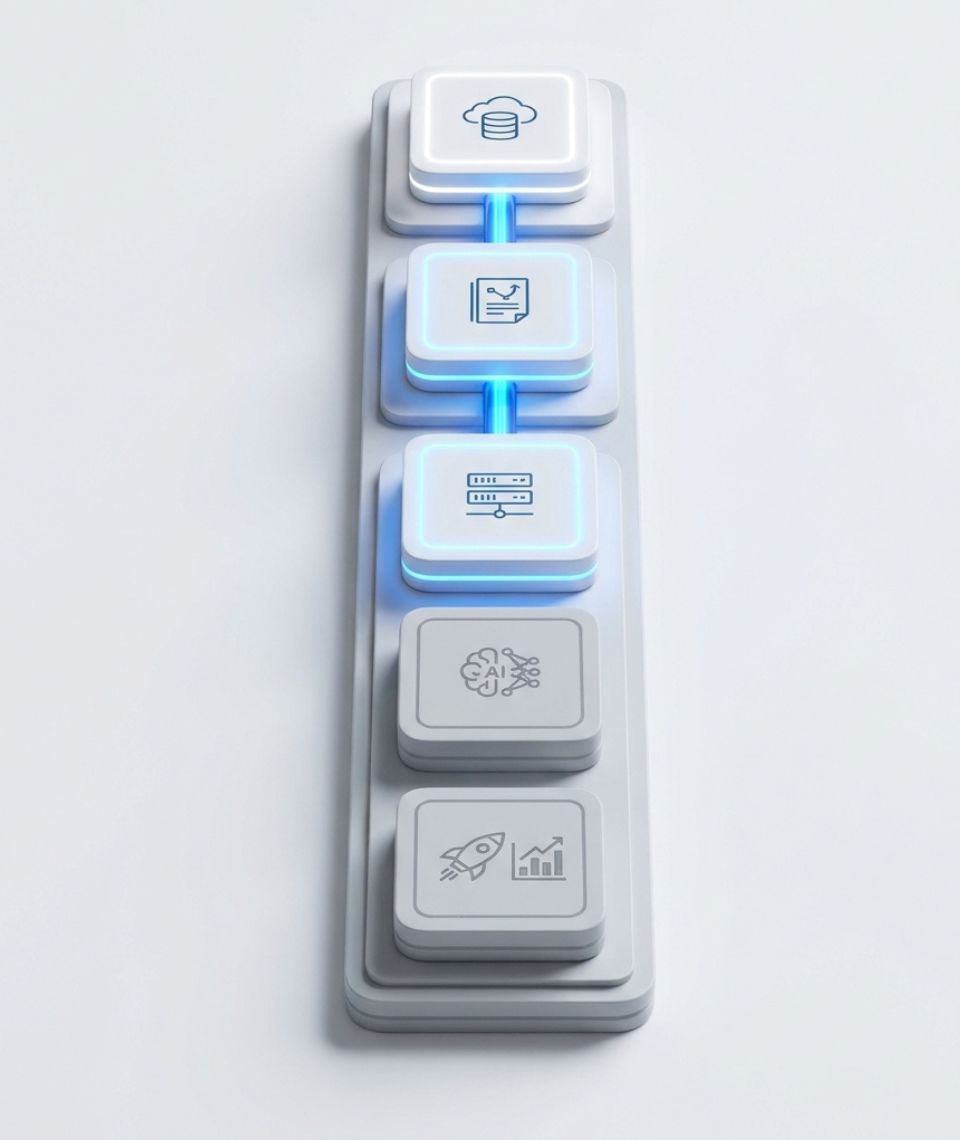
Q4 is budget planning season, and most 2027 AI budgets are being allocated right now on a mix of vendor demos, board pressure, and "we need to catch up." That is how 88 percent of pilots end up in the pile that never ships. A better approach exists, and it fits on one page.
The method: score your organization on the five readiness dimensions, fund the weakest dimension first, and only after that fund the model work. The model is the last mile of an AI investment, not the first.
Fund the weakest dimension first
The 5 Dimensions of Enterprise AI Readiness (Use Case Clarity, Operating Model and Ownership, Data and System Readiness, Governance and Risk, Delivery and Adoption Readiness) are not an audit framework for 2027. They are a budget allocation framework.
The reason is simple. The weakest dimension determines the ceiling on every AI project in your portfolio. Funding more model work when the weak point is governance produces faster failure, not better outcomes. Funding more data work when the weak point is use case clarity produces cleaner data for a project nobody will use.
The 2027 budget should be built in that order: diagnose the weakest dimensions, fund the work to lift them, then (and only then) fund the model and build work.
What budget looks like for each dimension
Use Case Clarity. If your pilots are stalling because the operator and the metric were never named, the budget line is a two week opportunity audit before any model build. Expect to spend $15,000 to $30,000 on an outside audit or two to four weeks of a senior internal lead's time. The output is a short list of use cases that can be funded with confidence.
Operating Model and Ownership. If your biggest 2026 lesson was that nobody wanted to maintain the models shipped in Q2, the 2027 budget needs a line item for the operating function. That might be a half FTE AI operations lead, a shared on call rotation that includes an engineering reviewer, or a managed services agreement with a delivery partner. Not funding this is funding future failure.
Data and System Readiness. If pilots are failing because the data pipeline cannot support production load, or the integration surface was never designed for scale, the budget line is modernization work. Database migration, event pipeline buildout, API hardening. This is unglamorous. It is also the line item that saves the second half of your 2027 roadmap.
Governance and Risk. If you shipped AI in 2026 without a written rollback plan or a model review process, the 2027 budget needs a one time investment in a governance framework (one month, $20,000 to $40,000) and ongoing budget for a quarterly review cadence. The EU AI Act and similar regulations are tightening, and mid market organizations without a framework in place by mid 2027 will be caught behind the schedule.
Delivery and Adoption Readiness. If your 2026 pilots shipped and then went unused, the 2027 budget needs change management and training as explicit line items. Not slides in the project plan. Dedicated budget for the receiving team to prepare, train, and run feedback loops during rollout. Underfunding this line is why so many "successful" pilots deliver zero operational value.
A simple 2027 budget allocation
For a mid market organization with a $500K to $1.5M AI budget, a sensible 2027 split looks something like this.
Readiness investments (bringing the weakest two dimensions up to a floor): 25 to 35 percent of the total. Opportunity audit, governance framework, operating model setup, change management capacity.
Platform and data work (making the environment production ready across clouds): 20 to 30 percent. Cloud agnostic by default. Platform choice should follow use case need, not the other way around.
Model, build, and integration (the actual AI work): 30 to 45 percent. Smaller than most leadership teams expect, because the readiness work is what makes this budget productive.
Reserve for 2027 learnings: 10 percent. Every roadmap gets wrong footed by at least one surprise. The team that builds in reserve ships what matters when the surprise arrives.
The organizations that split their budget this way in 2026 shipped more production AI than the ones that put 80 percent into model work and hoped the rest would sort itself out. The pattern holds for 2027.
Where to start the diagnosis
The faster the diagnosis, the earlier in Q4 the budget can be built. The Thessia Labs Enterprise AI Readiness Assessment scores your organization on all five dimensions in about five minutes. Fifteen questions, free, snapshot before contact details. The output is a dimension by dimension view of where to spend first and where to hold.
Across 2026, the organizations that funded readiness work ahead of model work shipped more production AI than the ones that put model work first. The 2027 budget is the moment to decide which pattern the organization follows next year.